Kundan vs. Meenakari: Understanding the Art Behind Your Bangles
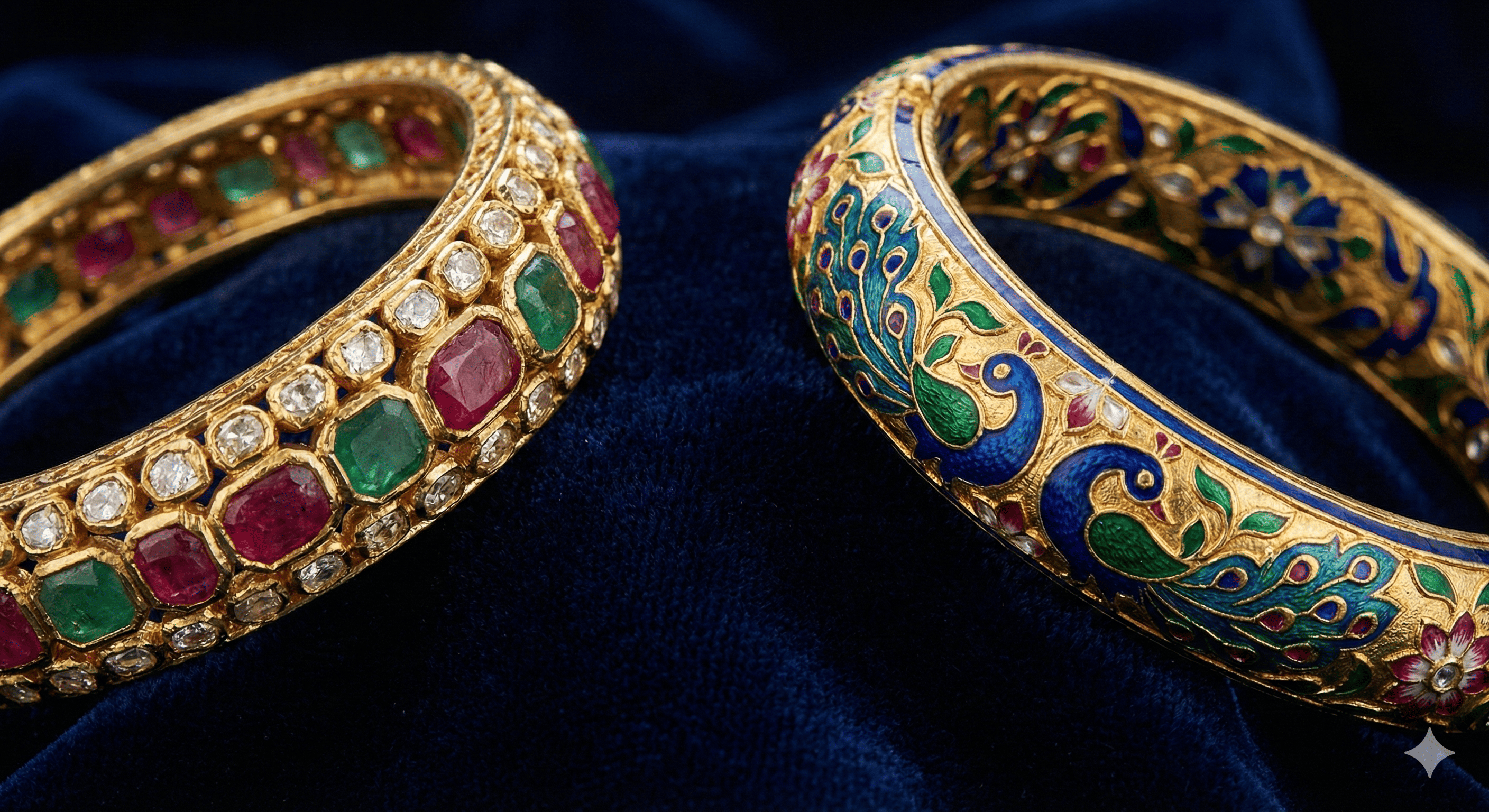
Two Pillars of South Asian Jewelry
When browsing the exquisite collections at The Kangan Tales, you will often encounter two primary art forms: Kundan and Meenakari. While both represent the pinnacle of South Asian jewelry craftsmanship, they are distinct techniques with very different aesthetic results.
What is Kundan?
Kundan is one of the oldest forms of gemstone jewelry setting in the world, originating in the royal courts of Rajasthan and the Mughal Empire. The word 'Kundan' refers to highly refined pure gold, which is used as a 'foil' to set uncut precious and semi-precious stones.
The process involves a goldsmith (Gharia) setting a stone — typically an uncut diamond, emerald, ruby, or colored glass — into a gold framework. The space between the stone and the gold is then filled with 24-carat Kundan (pure gold paste), which hardens and holds the stone in place without any prongs. The result is a seamless, ornate look where the stone appears to float within a bed of gold.
What is Meenakari?
Meenakari is the art of coloring the surface of metals by fusing brilliant colors on the metal — effectively enamel work on gold or silver. The word 'Meena' comes from the Persian 'Mina', meaning heaven. This technique was brought to Rajasthan by Raja Man Singh I in the 16th century from Persia.
In Meenakari, artisans engrave intricate patterns into metal, then fill each tiny groove with different colored enamels. The piece is then fired in a kiln at high temperatures to fuse the glass-like enamel to the metal surface. Multiple firings are often needed to build up layers of color. The vibrant result — often featuring peacocks, flowers, and geometric patterns in deep reds, greens, and blues — is uniquely breathtaking.
The Key Differences at a Glance
- Focus: Kundan focuses on the front-facing setting of stones, while Meenakari adorns the back and all surfaces of the jewelry with color.
- Visual Effect: Kundan is regal and gemstone-forward; Meenakari is painterly and colorful.
- Complementary: The finest Mughal pieces often combine both — Kundan on the front, Meenakari on the reverse.
- Durability: A high-quality Meenakari piece's enamel is kiln-fused and highly resistant to everyday wear.
Which Should You Choose?
If you are drawn to a classic, structured look with a focus on the shimmer of stones, choose Kundan. If you love bold, vibrant color and intricate surface patterns, Meenakari is your art form. And for the ultimate in bridal splendor, look for a piece that features both techniques.
Ready to explore true craftsmanship?
Shop The Collection